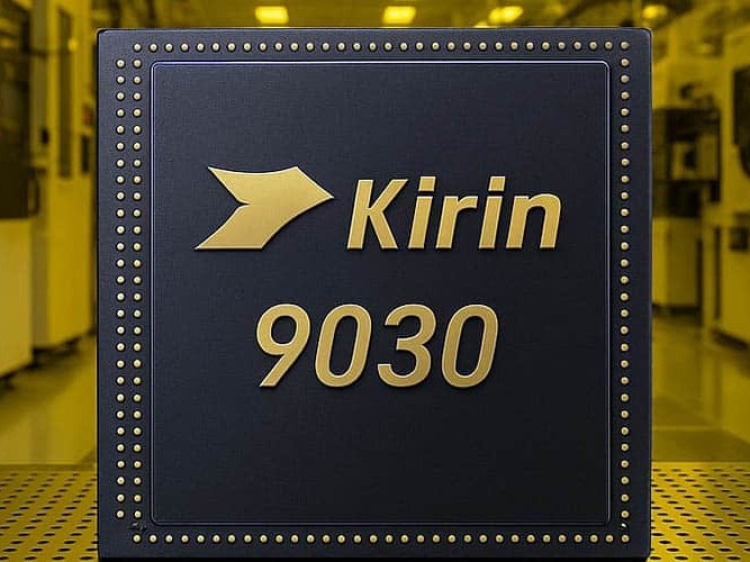
Huawei has rolled out the Mate 80 and Mate X7 smartphones powered by the Kirin 9030 and Kirin 9030 Pro. On paper, both chips look conservative rather than flashy, leaning on familiar ARMv8 CPU designs and Huawei’s Maleoon 935 GPU.
The standard Kirin 9030 uses eight ARMv8 CPU cores arranged across performance tiers, with the prime core clocking at 2.75GHz. Its performance cores run at 2.27GHz, while the efficiency cores sit at 1.72GHz, according to early benchmark leaks.
The Kirin 9030 Pro nudges things slightly further with nine ARMv8 CPU cores arranged in a 1+4+4 layout. Clock speeds appear identical to those of the non-Pro part, though testing suggests neither chip is yet running at full speed.
TechInsights has torn down the Mate 80 Pro Max and examined the Kirin 9030 silicon. It confirmed the chip is built on SMIC’s N+3 fabrication process, an evolution of its second-generation 7nm node.
That N+3 label does not mean parity with the 5nm processes from the leading foundries.
TechInsights reckons it lands somewhere between 7nm and 5nm, closer to a stretched 7nm than an actual node jump.
According to the analysis, SMIC achieved this by leaning heavily on DUV-based multi-patterning and Design Technology Co-Optimisation. This means that rather than shrinking everything cleanly, it is squeezing more out of what it already has.
DUV lithography relies on 193nm ultraviolet light, and by repeating patterning steps, it can carve finer structures. The catch is complexity, cost and a rising risk of defects with every extra step. DTCO tries to soften those problems by tuning design, manufacturing and yield together.
Used alongside aggressive multi-patterning, it helps limit edge-placement errors that would otherwise spiral out of control.
TechInsights found little evidence of significant improvements in fin pitch, contacted poly pitch or core transistor geometry. Front-end transistor scaling appears static mainly in the N+3 process.
Instead, most of the gains seem to come from the back end of the line, where interconnects are refined. That approach is risky because BEOL scaling with DUV demands extreme alignment accuracy, or yields fall off a cliff.
Each additional patterning step adds line roughness and defect exposure, making the whole flow fragile. It is a high-wire act rather than a comfortable manufacturing strategy. The Kirin 9030 shows SMIC is prioritising design discipline over any true lithographic shrink.
There is only so much performance left to unlock from DTCO before physics taps out.
Advanced packaging could still offer SMIC some headroom. For mobile application processors like Kirin 9030, though, that trick matters far less than it does in the server world.